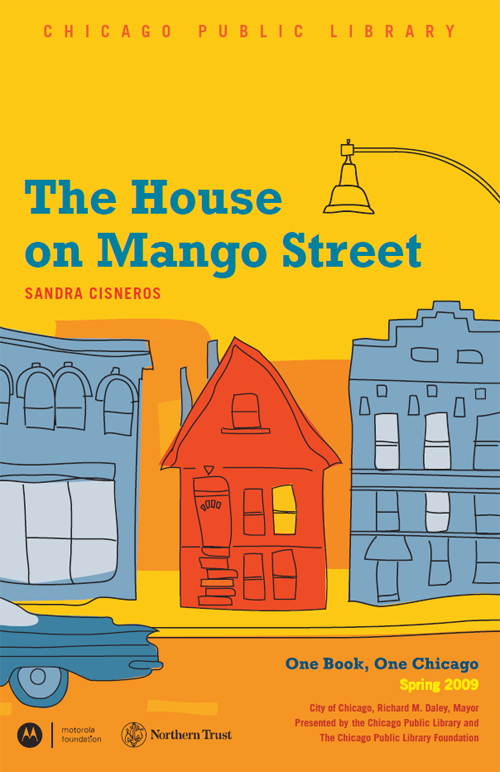
In Sandra Cisneros’s novel The House on Mango Street the main character, Esperanza, struggles to define herself outside of the circumstances she was born into.
Esperanza is a young, Latin American woman going through adolescence. We are shown the obstacles she is faced with during the pre-teen years of her life. One of the greatest obstacles she faces is defining herself and recognizing where she fits into her own story.
She frequently discusses the appearances, treatment, and roles of other women in the novel including her mother, great-grandmother, aunt, Rachel, Lucy, Nenny, and Sally. Esperanza’s depictions of these women reveal the qualities that are valued in a woman by Latin American culture. Women are always characterized by the way their appearance and their relationship to men. Esperanza is never able to describe herself in a positive way based on these standards. She doesn’t fit into this role.
She wants to be more powerful than the women in her life have been allowed to be, “but I have decided not to grow up tame like the others who lay their necks on the threshold waiting for the ball and chain.” (Cisneros 88) This quote shows Esperanza’s resilience and retaliation to her place as a Latina woman.
In the same section, “Beautiful and Cruel”, she goes on to explain how women who are both beautiful and cruel hold power without a man. Esperanza is exhibiting both the influence her community has had on her, and her will to defy the norm. She wants to be beautiful because she has been taught that beauty is an essential part of being a woman. She also wants to be powerful. This contrasts what she has been taught about how a woman should behave.
All other women that Esperanza describes in the novel are submissive in one form or another. One of the greatest examples of this is her great-grandmother. In the section “My Name” Esperanza tells how her great-grandmother was wild and independent until being forced into marriage. Esperanza details the way that her great-grandmother lived her life from a window seal regretting what she could have been. Esperanza uses this image to convey the fear of being stuck behind a window for her whole life.
Esperanza’s fear is captured in the line ” I have inherited her name, but I don’t want to inherit her place by the window.” (Cisneros 11) This shows her yearning to break free from the life she is stuck in. The circumstances that Esperanza was born into bind her to an identity that she does not fit.
Esperanza’s identity struggle is not only exhibited by the relationships she has with other women in the novel. It is also exhibited in the way she talks about herself. In the section “Four Skinny Trees” she describes how she feels like the lonely trees that grow despite being surrounded by concrete. Esperanza’s circumstances as a young Latin American woman have confined her in the same way the concrete confines the trees.
One of the most striking images of female conformity to cultural and social standards in the novel is Esperanza’s mother’s story of her days in school. “She can speak two languages. She can sing opera. She knows how to fix a T.V. But she doesn’t know which subway train to take to get downtown. I hold her hand very tight while we wait for the right train to arrive.” (Cisneros 90) Her mother used to possess qualities like passion and motivation, but her identity is far different from the “smart cookie” she once was.
This combination of learned traits and fierce independence is why Esperanza cannot define herself by any of the labels that exist in her community. She must make her own labels and define herself by her own terms. Cisneros used Esperanza’s struggle to show the complex identity of Latin American women.
Works Cited
Cisneros, Sandra. The House on Mango Street. New York City, Vintage Contemporaries, 2008, p. 11-90.
https://www.chipublib.org/wp-content/uploads/sites/3/2013/10/house-on-mango-street.jpg
 Kate's Latino/a Literature in English Blog